
If you still have old paper share certificates lying somewhere in your cupboard, then Let’s be honest – it’s the right time to sort them out. The stock market is almost fully digital now, and SEBI has made strict rules to make sure all investors move from physical shares to Demat.
That’s exactly why more people are searching for how to Convert Physical Shares to Demat without confusion, delays, or paperwork issues. By the way, the process is simple, but the updated rules can confuse anyone. So in this blog, we’ll break everything down in super easy English.
Let’s dive in.
Why SEBI Wants Everyone to Convert Physical Shares to Demat
SEBI observed that physical shares create too many problems such as:
- Chances of loss or damage
- Signature mismatches
- Fraud and fake certificates
- Delays in transfer
- Errors in name or address
To fix this, SEBI pushed everyone to Convert Physical Shares to Demat so transactions become faster, safer, and fully digital.
In fact, SEBI now wants the entire system to run electronically, which is why new rules keep coming from time to time.
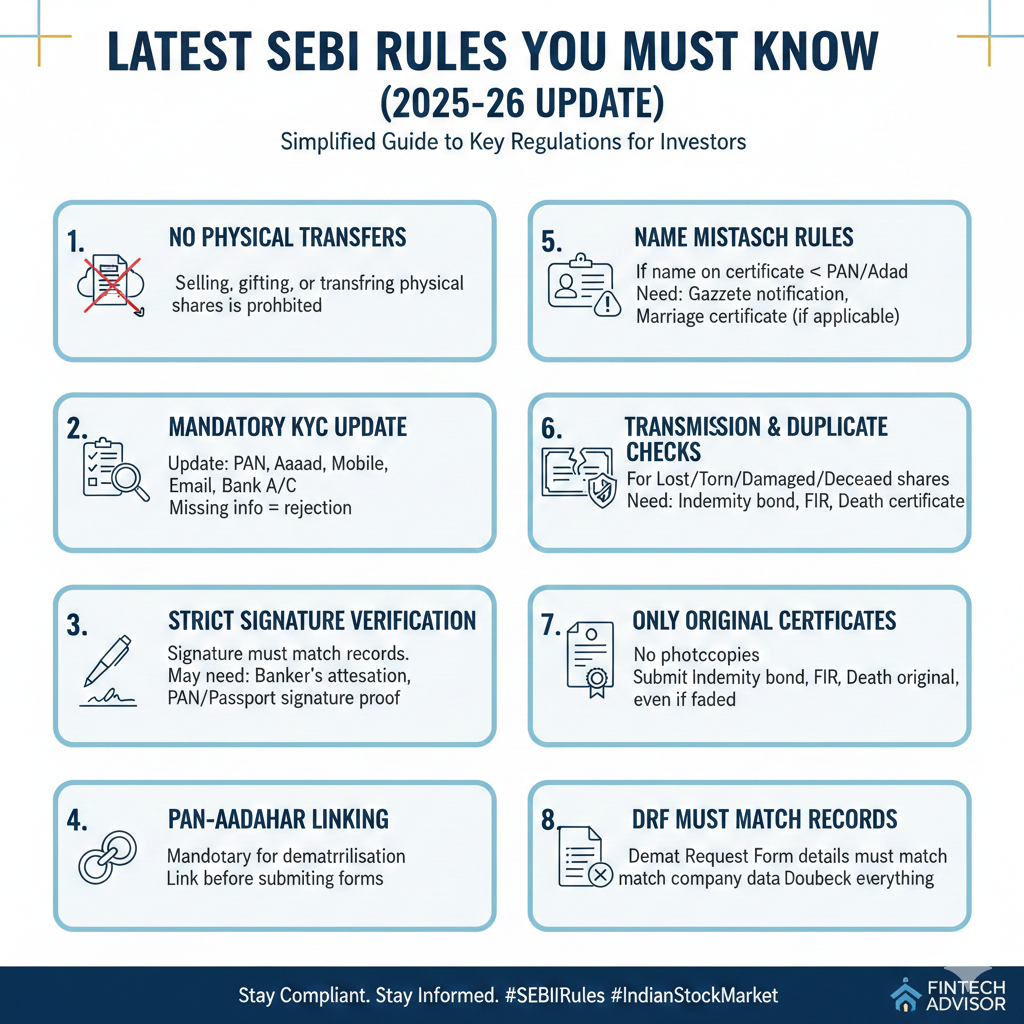
Latest SEBI Rules You Must Know (2025-26 Update)
Let’s break down the most important rules in simple language.
1. No Transfers Allowed in Physical Form
SEBI clearly said that companies cannot transfer physical shares anymore.
If you want to sell, gift, or transfer them, you must Convert Physical Shares to Demat first. There is no shortcut around this rule now.
2. Mandatory KYC Update Before Demat
You must update your:
- PAN
- Aadhaar
- Mobile number
- Email address
- Bank account details
If any of these are missing, your Demat request may get rejected.
3. Signature Verification Is Now Strict
Let’s be real – most people’s signatures change over time.
SEBI now asks for strict signature matching. If your signature doesn’t match with company records, you may need to give:
- A banker’s attestation
- PAN card signature proof
- Passport signature proof
Basically, sign carefully and keep your documents ready.
4. Mandatory Linking of PAN with Aadhaar
If PAN is not linked to Aadhaar, companies will straightaway reject the dematerialisation request. So link it before you submit your form.
5. Name Mismatch Rules Updated
If your name on the share certificate is different from your PAN or Aadhaar (even slightly), SEBI needs:
- Gazette notification
- Marriage certificate (if applicable)
- Gazette for name change after marriage (if needed)
Frankly, name mismatch is the biggest reason for delays, so get it fixed early.
6. Transmission and Duplicate Certificates Have New Checks
If shares are:
- Lost
- Torn
- Damaged
- Held by a deceased person
SEBI needs stronger documentation like indemnity bonds, FIR copies, or death certificates.
Only then you can Convert Physical Shares to Demat without getting stuck.
7. Physical Certificates Must Be Original
SEBI doesn’t accept photocopies. Even if your certificate is faded or old, the original must be submitted.
8. Demat Request Form (DRF) Must Match Company Records
Even a small spelling difference can delay your request.
So double-check everything.
Step-by-Step Process to Convert Physical Shares to Demat
Let’s simplify the process, because honestly, it’s not as complicated as it sounds.
Step 1: Open a Demat Account
If you don’t have a Demat account, open one with any broker:
- Zerodha
- Groww
- Upstox
- ICICI Direct
- HDFC Securities
Anyone is fine, just choose a reliable DP.
Step 2: Fill the Dematerialisation Request Form (DRF)
Your broker will give you a DRF. Fill it carefully.
A few simple rules:
- Don’t overwrite
- Don’t sign in a hurry
- Make sure your name matches with your ID proofs
Step 3: Submit Original Physical Share Certificates
Attach your share certificates with the DRF.
By the way, write “Surrendered for Dematerialisation” on each certificate.
Step 4: DP Verifies Your Documents
Your broker checks everything and sends it to the company’s registrar.
Step 5: Registrar Processes Your Request
If the registrar finds any mismatch, they will ask for:
- KYC update
- Signature proof
- Name correction documents
If everything is perfect, they approve your request.
Step 6: Shares Get Credited to Your Demat
Once approved, the shares directly reflect in your Demat account.
Usually, this takes 15–30 days.
Why You Should Convert Physical Shares to Demat Now
Here’s the truth: the longer you wait, the harder it becomes.
Old certificates fade, signatures change, names change after marriage, and documents get lost.
When you Convert Physical Shares to Demat, you get:
- Zero risk of loss or theft
- Instant selling option
- Online tracking
- Faster settlements
- Peace of mind
Plus, SEBI might bring even stricter rules in future, so earlier is always better.
Common Reasons for Rejection
People often face issues like:
- Signature mismatch
- Wrong ISIN
- Torn certificates
- Missing KYC
- PAN-Aadhaar not linked
- Name spelling mistakes
Just fix these before you apply.
Final Thoughts
Let’s be honest – the older generation never imagined everything would go digital this fast. But today, the stock market runs on Demat, and physical certificates are practically useless until you convert them.
If you still have old certificates at home, don’t wait. Just start the process and Convert Physical Shares to Demat before rules get harder or documents get misplaced.
Take it slow, follow SEBI rules, and you’re good to go.
If you need expert help to Convert Physical Shares to Demat without delays, check our detailed service page here
FAQs
1. Can I sell physical shares without converting them?
No. You must Convert Physical Shares to Demat before selling.
2. How long does the demat process take?
Usually around 15–30 days.
3. What if my certificate is damaged?
You can apply for a duplicate certificate and then dematerialise it.
4. What if my name is different on the certificate?
You need proper name-change documents. SEBI is strict about it.
5. Can senior citizens convert shares easily?
Yes. They just need proper KYC documents and signature verification.
Follow Share Claimers on Facebook, Instagram, and YouTube for important updates, insights, and news.